
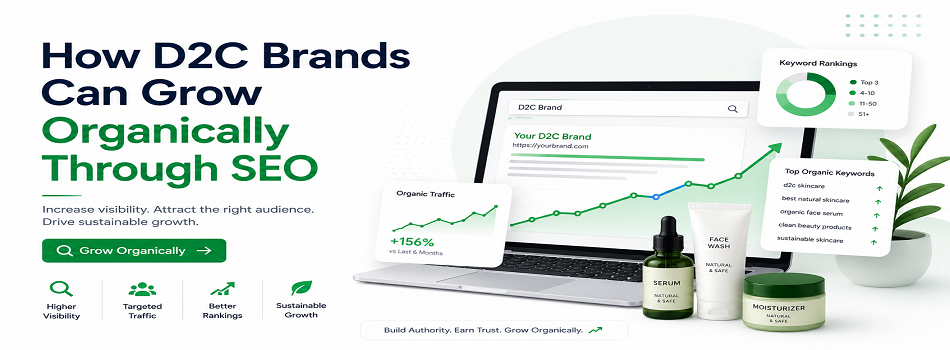
How D2C Brands Can Grow Organically Through SEO
D2C brands in India are growing faster than ever. From skincare, fashion, food, wellness, home décor, pet care, personal care, and lifestyle products, new brands are entering the market every month.
But there is one common challenge almost every D2C founder faces.
Paid ads are becoming expensive.
Meta ads, Google ads, influencer campaigns, marketplace commissions, and discount-led sales can bring quick visibility, but they also increase customer acquisition cost. A brand may get sales today, but if every sale depends only on paid ads, growth becomes expensive and unstable.
This is where SEO becomes a powerful growth channel for D2C brands.
SEO helps your brand appear on Google when people are already searching for your product, category, problem, or solution. It allows your website to attract high-intent customers without paying for every click.
For a D2C brand, SEO is not just about traffic. It is about building discoverability, trust, organic sales, repeat visibility, and long-term brand authority.
Why SEO Matters for D2C Brands
D2C brands usually start with performance marketing because it gives quick results. But over time, paid ads alone can become risky.
If ad costs increase, your margins suffer.
If your account gets restricted, sales drop.
If competitors outbid you, your CPL or CAC goes up.
If your creatives stop performing, campaigns slow down.
SEO gives your brand a more stable foundation.
When your website ranks for product, category, and problem-solving keywords, customers can discover your brand naturally. This creates a long-term growth engine that does not depend only on paid campaigns.
For example, a skincare brand should not only depend on ads for “buy face serum”. It should also rank organically for searches like:
Best serum for oily skin
How to reduce pigmentation naturally
Vitamin C serum for glowing skin
Best moisturiser for dry skin
Sunscreen for Indian skin tone
These searches show real buying intent. If your brand appears at the right moment with the right content, you can attract users who are already interested.
D2C SEO Is Different from Regular SEO
SEO for a D2C brand is not the same as SEO for a normal service website.
A D2C website needs SEO across multiple layers:
Homepage SEO
Category page SEO
Product page SEO
Blog SEO
Technical SEO
Image SEO
Schema markup
Review optimisation
Internal linking
Conversion-focused content
Mobile speed optimisation
This is why many brands prefer working with an experienced ecommerce seo company india instead of using generic SEO support.
A strong ecommerce SEO team understands how people search before buying. They know how to optimise product pages, collection pages, buying guides, comparison pages, and educational blogs in a way that improves both ranking and conversions.
Start with High-Intent Keyword Research
Keyword research is the foundation of SEO. But D2C brands should not target random high-volume keywords.
The focus should be on buyer intent.
There are usually four types of keywords a D2C brand should target:
Informational keywords
Commercial keywords
Transactional keywords
Brand keywords
For example, if you sell organic tea, your keyword strategy may include:
Informational: Benefits of green tea for digestion
Commercial: Best organic tea brands in India
Transactional: Buy organic green tea online
Brand: Your brand name + green tea
This helps you reach customers at every stage of the buying journey.
A common mistake D2C brands make is writing blogs only for traffic. Traffic is useful, but traffic without buying intent does not always generate sales. Your SEO content should attract people who may become customers.
Optimise Category Pages for Sales
For D2C websites, category pages are very important.
If you sell skincare, your category pages may include:
Face serum
Moisturisers
Sunscreen
Face wash
Body care
Hair care
These pages can rank for high-intent keywords and bring customers directly to product collections.
A well-optimised category page should include:
Clear heading
Short SEO-friendly introduction
Product listings
Filters
Customer reviews
FAQs
Internal links
Relevant keywords
Strong call-to-action
For example, instead of just having a page called “Serums”, a better SEO page could be:
Vitamin C Serum for Glowing Skin
Hydrating Face Serum for Dry Skin
Niacinamide Serum for Oily Skin
This makes your category pages more search-friendly and more conversion-focused.
Improve Product Page SEO
Product pages are where visitors become buyers. But many D2C brands make the mistake of copying short product descriptions from packaging or marketplaces.
Google needs unique, helpful, and detailed content to understand and rank your product pages.
A good product page should include:
SEO-friendly product title
Clear product description
Benefits
Ingredients or material details
How to use
Who it is for
Why it works
Customer reviews
FAQs
Delivery and return information
High-quality images
Schema markup
For example, instead of writing:
“Natural face cream for glowing skin.”
A better version would be:
“Our lightweight natural face cream is designed for daily hydration, dullness, and uneven skin texture. Made with skin-friendly ingredients, it helps keep your skin soft, fresh, and naturally radiant without feeling greasy.”
This sounds human, useful, and conversion-friendly.
Use Blogs to Educate and Convert
Blogs are one of the best ways for D2C brands to build organic visibility.
But blogs should not be written only for SEO. They should answer real customer questions.
For example, a D2C fashion brand can write:
How to Style Cotton Co-ord Sets for Summer
Best Travel Outfits for Women in India
Cotton vs Polyester: Which Fabric Is Better for Daily Wear?
A wellness brand can write:
How to Choose the Right Protein Snack
Healthy Evening Snacks for Working Professionals
Why Millet-Based Snacks Are Becoming Popular in India
A home décor brand can write:
How to Choose Handmade Table Linen for Your Home
Best Home Décor Gifts for Housewarming
How to Style Your Dining Table for Special Occasions
These blogs bring people to your website before they are ready to buy. Once they trust your content, they are more likely to explore your products.
Build Topic Clusters Around Product Categories
One of the smartest SEO strategies for D2C brands is topic clustering.
This means creating multiple blogs around one product category and linking them back to the main category page.
For example, if you sell sunscreen, your content cluster can include:
Best sunscreen for Indian weather
SPF 30 vs SPF 50: Which is better?
How often should you apply sunscreen?
Sunscreen for oily skin
Sunscreen under makeup
Mineral sunscreen vs chemical sunscreen
All these blogs should link back to your main sunscreen category page.
This helps Google understand that your website has authority on that topic. It also helps users move from education to purchase.
Focus on Technical SEO
Even the best content will struggle if your website has technical problems.
D2C websites often face technical SEO issues because of product filters, duplicate pages, slow images, app scripts, tracking codes, and poor mobile speed.
Technical SEO includes:
Website speed optimisation
Mobile usability
Clean URL structure
Indexing fixes
Canonical tags
Structured data
Image compression
Broken link fixes
Sitemap optimisation
Robots.txt review
Duplicate content control
For ecommerce brands, speed is extremely important. If your website is slow, users may leave before buying. A fast website improves both SEO and conversion rate.
This is where affordable seo services india can help D2C brands improve their website health without hiring a full in-house SEO team.
Make Your Website Mobile-First
Most D2C customers browse and shop on mobile.
If your website looks good on desktop but loads slowly on mobile, you may lose sales.
Your mobile website should have:
Fast loading speed
Clear product images
Easy navigation
Simple filters
Visible price and offers
Easy add-to-cart button
Smooth checkout
WhatsApp or call support
Trust badges
Customer reviews
Google also considers mobile experience important for rankings. So mobile-first design is not only a user experience requirement. It is also an SEO requirement.
Use Image SEO for Product Discovery
D2C brands depend heavily on visuals. Product photos, lifestyle images, before-after images, packaging shots, and lookbook images can all support SEO.
Image SEO includes:
Compressed images
Descriptive file names
Alt text
WebP format
Image sitemap
Fast-loading product images
For example, instead of uploading an image named IMG_001.jpg, use a file name like:
organic-vitamin-c-face-serum-india.webp
This helps Google understand the image better and can improve visibility in Google Images.
Add FAQs to Product and Category Pages
FAQs are powerful for both SEO and conversions.
They help answer buyer objections directly.
For example, a skincare product page can include:
Is this product suitable for oily skin?
Can I use it daily?
Is it safe for sensitive skin?
How long does delivery take?
Can I use it with sunscreen?
A clothing brand can include:
Is the fabric pure cotton?
Is the product hand printed?
Will the colour fade after washing?
What is the return policy?
Is it suitable for summer?
FAQs help users make decisions faster. They also give Google more relevant content to understand your product page.
Build Trust with Reviews and UGC
Trust is very important for D2C brands because customers are buying directly from your website.
SEO can bring visitors, but trust converts them.
Add customer reviews, ratings, testimonials, user-generated content, and real product photos wherever possible.
Reviews can also help with long-tail keyword visibility because customers naturally use words and phrases that other buyers search for.
For example, a customer may write:
“Perfect cotton robe for summer.”
This can support ranking for long-tail searches related to cotton robes, summer clothing, or comfortable homewear.
Create Comparison and Buying Guide Pages
D2C customers often compare before buying.
This creates a great SEO opportunity.
Your brand can create pages like:
Best Face Serum for Oily Skin in India
Cotton Robe vs Satin Robe: Which One Should You Choose?
Best Healthy Snacks for Office
Best Handmade Gifts for Women
How to Choose the Right Baby Skincare Product
These pages attract users who are actively considering options. They are not just browsing. They are evaluating.
A strong ecommerce seo company india can help you identify such high-conversion content opportunities and create pages that educate while naturally guiding users towards your products.
Optimise for Brand Search
As your D2C brand grows, more people will search for your brand name on Google.
You should control what they see.
Optimise your homepage, about page, product pages, reviews, social profiles, and Google Business Profile if applicable.
Your brand search results should show:
Official website
Product pages
Social profiles
Positive reviews
Marketplace listings if relevant
PR mentions
Founder story
FAQs
This builds credibility and reduces dependency on marketplaces.
Use SEO with Paid Ads for Better Results
SEO and paid ads should not work separately. They should support each other.
Paid ads can show which products and messages convert faster. SEO can use that data to create long-term organic pages.
For example, if your Meta ads show that “glow serum for dull skin” converts well, you can create SEO content around:
Best glow serum for dull skin
How to fix dull skin naturally
Vitamin C serum for dull skin
Similarly, if a Google Ads keyword is giving expensive but high-quality conversions, you can target it through SEO to reduce long-term acquisition cost.
Measure the Right SEO Metrics
D2C brands should not measure SEO only by rankings.
You should track:
Organic traffic
Category page visits
Product page visits
Add-to-cart from organic traffic
Organic revenue
Conversion rate
Keyword rankings
New vs returning visitors
Assisted conversions
Bounce rate
Search Console clicks
Top landing pages
Customer acquisition cost
The goal of SEO is not just more visitors. The goal is more relevant visitors who can convert into customers.
How Long Does SEO Take for D2C Brands?
SEO is not instant. It usually takes 3 to 6 months to show meaningful improvement, depending on website quality, competition, content, product demand, and technical health.
For a new D2C brand, the first few months should focus on:
Technical SEO fixes
Keyword strategy
Category optimisation
Product page improvement
Blog planning
Internal linking
Content creation
Tracking setup
After that, the brand can start seeing gradual growth in impressions, clicks, rankings, and organic sales.
SEO should be seen as a long-term asset, not a one-time activity.
Why D2C Brands Should Invest in SEO Early
Many brands wait until paid ads become too expensive before starting SEO. This is a mistake.
SEO takes time to build. The earlier you start, the stronger your organic foundation becomes.
Starting early helps you:
Build authority before competitors
Reduce paid ad dependency
Improve website structure
Create helpful content
Rank for product keywords
Improve customer trust
Lower acquisition cost over time
Even if SEO does not become your biggest revenue channel immediately, it can become one of your strongest growth channels over time.
How Connective9 Helps D2C Brands Grow Through SEO
Connective9 helps D2C and ecommerce brands build SEO strategies that are focused on visibility, traffic, and business growth.
Our approach is not limited to keyword ranking. We work on the complete organic growth journey, including ecommerce SEO, category optimisation, product content, blog strategy, technical SEO, landing page improvement, and conversion-focused content.
Whether you are a new D2C startup or an established ecommerce brand, our SEO team can help you build a stronger organic presence and generate more qualified traffic from Google.
If you are looking for affordable seo services india or an experienced ecommerce seo company india, Connective9 can help you create a practical SEO roadmap for sustainable growth.
Conclusion
D2C brands cannot depend only on paid ads forever. Ads can bring fast results, but SEO builds long-term visibility, trust, and organic sales.
A strong SEO strategy helps your brand rank for product searches, educate customers, improve website performance, and reduce customer acquisition cost over time.
For D2C brands, SEO is not just a marketing channel. It is a growth asset.
The brands that start investing in SEO today will have a stronger advantage tomorrow.
For a customised SEO growth plan for your D2C brand, visit connective9.com and connect with the Connective9 team.
FAQs
1. Why is SEO important for D2C brands?
SEO helps D2C brands attract customers organically from Google, reduce dependency on paid ads, improve product visibility, and build long-term brand trust.
2. How can D2C brands grow organically through SEO?
D2C brands can grow organically by optimising product pages, category pages, blogs, website speed, mobile experience, internal linking, reviews, and high-intent keywords.
3. What are affordable SEO services in India?
Affordable SEO services in India include keyword research, technical SEO, on-page optimisation, blog content, product page SEO, local SEO, reporting, and organic growth strategy at a practical cost for growing businesses.
4. Why should a D2C brand hire an ecommerce SEO company in India?
An ecommerce SEO company in India understands product page optimisation, category SEO, technical ecommerce issues, schema, content strategy, and organic sales growth for online stores.
5. How long does ecommerce SEO take to show results?
Ecommerce SEO usually takes 3 to 6 months to show visible results. The timeline depends on competition, website health, content quality, backlinks, and product demand.
6. Can SEO reduce paid ad costs for D2C brands?
Yes. SEO can reduce long-term dependency on paid ads by bringing organic traffic and sales from Google. It may not replace ads completely, but it can help lower customer acquisition cost over time.

